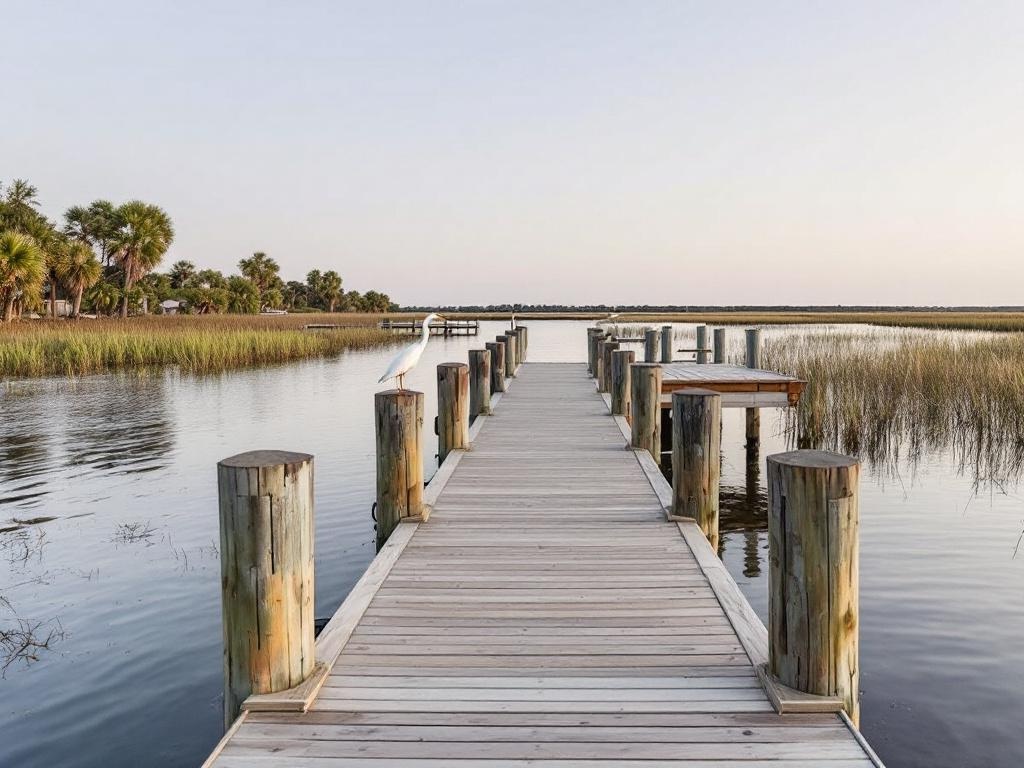
A Dock on the Calibogue Sound
Last spring we drove pilings for a dock at a Windmill Harbour property where the previous structure had lasted eight years before the framing gave out. The homeowner had hired an inland contractor the first time around. The bolts were standard zinc-plated, the pilings were set shallow, and the decking was fastened with screws that weren't rated for salt air. By year five, the hardware was bleeding rust. By year eight, the dock was unsafe to walk on.
We replaced it with concrete-encapsulated pilings, marine-grade aluminum framing, and composite decking over stainless connections. That dock will outlast the next three roofs on the house behind it. Both docks cost about the same. The first one used materials that weren't specified for saltwater.
Calibogue Dock Works builds docks, piers, boat lifts, and marine structures for Hilton Head Island and the surrounding Lowcountry. Every project is designed for your waterfront's specific conditions: tidal exposure, wind classification, vessel requirements, and HOA standards.
What Saltwater Does to a Dock
The South Carolina coast corrodes unprotected steel at roughly 5 mils per year. A standard deck screw loses structural capacity in under four years. Marine-grade fasteners in the same environment last decades.
Saltwater attacks metal through galvanic corrosion, accelerated in warm water. It breeds marine borers that hollow out unprotected wood pilings from below the waterline, where damage stays invisible until the piling fails. Tidal currents scour sediment from around piling bases, undermining structures that weren't embedded deep enough. Hurricane surge applies lateral forces that test every connection in the dock simultaneously.
None of this is unusual for the Lowcountry. It's the normal operating environment. Your dock will face these conditions. The design determines whether it survives them.
How We Engineer for It
Tidal calculation: We survey your specific tidal range across multiple cycles. Dock height is set for boat access at mean low water with adequate freeboard at king tides. Two feet of error in either direction makes a dock impractical.
Hardware grade: Every fastener, bracket, and connection is specified as G-185 hot-dip galvanized or 316 stainless steel. We don't mix metals in contact with each other, which accelerates galvanic corrosion in salt air.
Piling protection: Timber pilings receive marine-grade ACQ treatment. For open sound exposure and hurricane zones, we specify steel-reinforced concrete pilings that eliminate marine borer concerns entirely and resist storm surge loads that snap timber.
Storm tolerance: Engineered breakaway connections at specific points protect the main structure when surge exceeds design parameters. The dock absorbs what it can and sheds what it must.
Fifteen Years on Lowcountry Water
We've built docks across Sea Pines, Palmetto Dunes, Windmill Harbour, and Shelter Cove. We've worked the protected creeks off Broad Creek and the open sound frontage along the ICW. We've coordinated permits with Beaufort County and navigated HOA architectural review for communities across the island.
The conditions at a marsh-side lot in Palmetto Dunes share almost nothing with an exposed point on the Calibogue Sound. We engineer for each site accordingly.
Let's talk about your waterfront: call (843) 502-6361 for a free consultation.